The End of an Aeon: The War with Alar
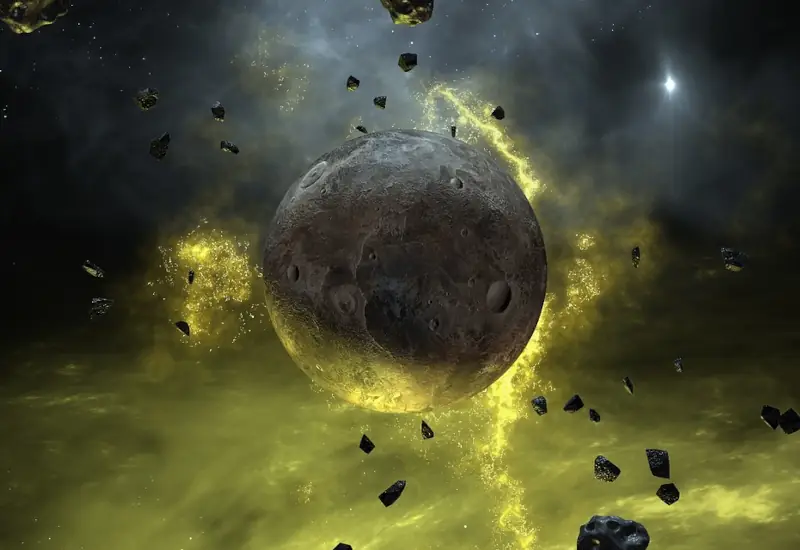
"Astronomy, Space, Moon image" by Mikkehouse (resized) via pixabay
"We are at our best when we move together, and we are at our worst when we move together."
- Delenn about the Minbari, "Ceremonies of Light and Dark," Babylon 5
After making peace in their own universe and staying at a safe distance in the next few, war became a distant memory for most Carcosans - until the aeon of Alar. The people of the new universe only grew more vicious over time; greed and wrath became their weapons, shields, and blinders. Efforts at peace quickly died on the vine, until they were abandoned altogether. Competition and force ruled the cosmos as twelve interstellar civilizations warred across the stars, just as their maker had designed.
A Deadly Discovery
Three Alari cultures were wiped out by the time one of them discovered the gravitational shield around Carcosa. This clan focused on advanced technology rather than proliferation or brute force, which was why they had the means to detect a black hole that was in fact hollow. They even discovered Resonance emanating from it. Eventually, they figured out how to replicate the waves they detected and, most importantly, how to disrupt them, while Carcosa was none the wiser.
The Alari had no reason to suspect the secret civilization was anything other than their own kind. They assumed a cowardly thirteenth clan had hidden itself, waiting to strike when others were brought low. So they outfitted a star cruiser to pierce The Shell and destroy everything they had learned about Carcosan infrastructure. When the suicidal leap into the heart of a black hole didn't kill them, they delivered their ultimatum: Surrender your technology and energy or be annihilated. To prove their point, they let their great sonic cannon loose on the nearest planet, aiming at the harmonics of Resonance itself.
It worked, and Hali - home to the Great Hall of the House of Day - shattered down to its core. The planet exploded, the atmosphere ignited, and the entire population of Carcosans was killed.
At least, that's what the Alari believed.
A Terrible Cost
The experience devastated Carcosa as the weapons nullified their very language, leaving the population deafened, divided, and defenseless. This was only part of the reason they were unable to give a reply, however. As Resonance restabilized, many gravitated to nearby planets to learn what happened and get new Masks. But some, confused and disharmonized, were left to float amongst the rubble and others were lost, instantly and forever.
But the Shell Piercer did more than destroy Hali and the Masks of everyone on it. For the first time in Carcosa's history, one of the eleven Avatars fell silent. Weyland 1, Avatar of the House of Day, was decimated in the blast. His complete and sudden destruction left a terrible void, not only in the order of Houses but in Fenric and the House of Night. His brother lost, Fenric burned with the rage that swept through his House. Carcosans did not wage war, but they were completely unwilling to accept death and the end of their civilization.
Sunrise, Parabellum 2
Yet it was not the Avatars' place to decide how Carcosa would respond. That choice was made by Queen Camilla of the House of Stars, and the options she weighed were grim. A purely defensive war would be costly. If they only retaliated against those who attacked, others would eventually come to finish their work. They would never again be safe in the Alari aeon, so Carcosa would have to destroy not just its people and worlds, but the entire universe itself.
So Queen Camilla called her people to prepare for war with one vital caveat: there was to be no siege and no extended torment, only swift and complete destruction.
Given a direction, all of Carcosa moved as one. Science in all Houses shifted from ongoing projects to defense. The House of Night, which was most familiar with their siblings' work, repurposed current technology for annihilation. Transplants from later aeons who were more familiar with war led the efforts with startling efficiency. Ultimately, a plan took shape: the universe would be harvested into singularities so its destruction would fuel Carcosa's energy needs for aeons to follow.
Alar Delenda Est 3
"The longest it took us to destroy a solar system was 10 seconds."
- River, Alar Robardin
When the time came to strike back, Carcosa did so with decisive force. Projectiles no larger than human fingers were launched into Alar's inhabited planets and once their casings cracked, gravity took care of the rest. The House of Night did not obey Camilla's decree to the letter, however, though they did not openly defy it. They left the world that had attacked them for last so the worst offenders would know terror as stars went out around them. Then, when only a single star and one inhabited planet remained, they moved in.
The last of the Alari space fleet was obliterated not with flashes of light or fire, but with small ships armored in gravitational plates that absorbed projectiles, light, and even the sonic disruptions like the one that laid Hali to waste. Then the invasion began in earnest. With dark matter blades and empowered armor, the bravest Carcosans killed every living thing that remained. In the rare event of defeat, drop ships nearby were loaded with Masks just waiting to serve as instant replacements.
And when the extermination was finished, they took the planet back through The Shell to replace the one they had lost. Some say this act was trophy-taking; others consider it a memorial to those who were lost. In the end, it was claimed by the House of Crows, to be studied, reviewed, and picked clean forever. Soldiers who faced the Alar in battle were given a title: Alar Robardin 4 (often simply "Robardin," for short). And of course, there was the story to be told.
Nothing else from Alar, including the name of its creator, remains for mortals to find. This void stands as an enduring lesson: Do not wage war with those under the Yellow Sign.
The Aftermath
An Eldritch Treaty
The Treaty of Carcosa is, thus far, unique in all existence. You could say it was fashioned for gods by gods, but both Hastur and Yog-Sothoth took part in its making. Although his children had triumphed over Alar, Hastur knew they never wished to repeat the experience. A pact of non-interference offered them the best chances to move forward without bloodshed. The resulting agreement has been delivered by Yog-Sothoth to every nascent creator since.
The terms are few but firm: Carcosa will be allowed to exist in peace in the current universe and collect material of no great importance to support itself. Its people will be allowed to visit but accept the risks of everyday dangers when doing so. If they lose Resonance and cannot return to Carcosa or choose a new home, they will be allowed to stay and attempt to integrate. In return, The Shell will be positioned far from native sentient life and Carcosa will not interfere with the reigning maker's design for its aeon. Visiting Carcosans will avoid making waves by hiding their nature from the public and leaving social power to the locals. And by learning about the macrocosm, Carcosa will remember it, even when time no longer can.
Any significant breach of the terms will result in the utter ruin of the current aeon. Negotiations beforehand are not promised. The mercy of a swift end may be all that stands between the creator and all it has made and oblivion.
A Lasting Shift
In more recent aeons, the war with Alar continues to echo but few wish to discuss it. No one in Carcosa had wanted such an awful turn of events but all were changed by it. Traumas took time and effort to soothe and without Weyland, the House of Day, and Hali, daily life was never the same. Worse still, they could not afford to put their weapons and armor aside for good. Though they did not use them at home save for practice, the House of Night became the military arm of Carcosa, gathering martial arts from across the stars and perfecting the technology that would keep Carcosans safe.
This many aeons later, a larger percentage of the population was not present for the war. Later transplants remember battles in their native lands but cannot conceive of slaughter on such a scale or the deeper scar that remains: Alar proved that Carcosa had not completely transcended death and destruction after all, and the horror of that truth can never be fully reckoned with.
Notes
Per Tardis Wiki: "Weyland, also known as Volund, was an Elder God that battled with Fenric. His natural form contained many colours." See also Wayland the Smith (Norse Myth). Return ↑
Per Disco Elysium Wiki: "'Sunrise, Parabellum,' an old revolutionary saying meaning "Sunrise, Prepare-for-War," is a favored phrase among cops." Return ↑
Per Wikipedia: "Ceterum (autem) censeo Carthaginem esse delendam ("Furthermore, I think that Carthage must be destroyed"), often abbreviated to Carthago delenda est or delenda est Carthago ("Carthage must be destroyed"), is a Latin oratorical phrase attributed to Cato the Elder, a politician of the Roman Republic." Return ↑
"the spirit Hoseib Alar Robardin" is the reported narrator of "An Inhabitant of Carcosa." Return ↑