Propaganda vs. the Eldritch
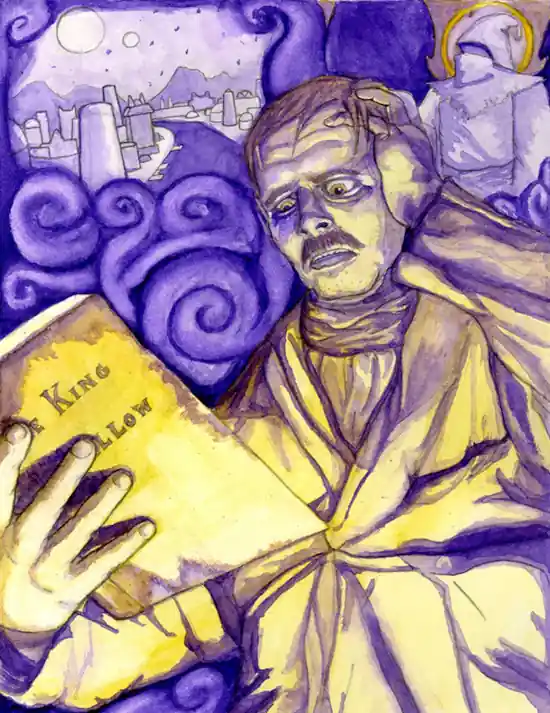
"File:Repairer of Reputations Chapter 1.jpg" by Tucker Sherry / Amazing Moondog (resized) is licensed under CC BY-SA 4.0

"A voice from other epochs belongs in a graveyard of other epochs."
- H. P. Lovecraft, "At the Mountains of Madness"
Where It Begins
Eldritch beings have fearsome reputations for many reasons; misunderstandings, unintended consequences, and cruel impulses are only a few of them. But people need never encounter the eldritch to fear them. Warnings against these strange interlopers can be accidental or intentional, homegrown or government-issued, recent or passed down from generation to generation, but they usually originate from two common routes.
Historic Horror
Refugees from prior aeons can visit the present universe at nearly any point. When they emerge, they often have better means of survival due to their powers or technology. But meeting native societies doesn't always go well. If they fail to blend in, eldritch transplants will stand out and how they're received may have less to do with their intentions than how they're perceived. Some are revered as gods, at least for a time; many are reviled as monsters somewhere down the line. The more terror they inspire, the more cautionary folktales and taboos result.
Purposeful Propaganda
Intruders from dead aeons always threaten the status quo to some degree. Even a single entity can seem threatening if its power is great enough or it influences its environment in startling ways. And the more cosmic refugees gather, the more locals will fear an invasion. Anyone hoping to hold power in the present aeon can easily come to loathe the eldritch, from the lowliest mortal leader to the maker itself. Whether these otherworldly interlopers actively seek power or not, they disrupt familiarity and predictability and make current leaders seem useless.
Direct attacks may not be feasible, however. Fears of what aliens might be able to do can give anyone pause. Rumors - or worse yet, proof of their prowess - can make a war seem far too costly. And technical disadvantages can make battles effectively impossible to win. After all, what can a Stone Age society do against the Carcosans, whose spaceships wield singularities as both weapons and shields? Not much.
But propaganda campaigns can be insidiously effective. Once someone realizes an opponent's strangeness, it isn't difficult to use it against them. It doesn't take much to make something that isn't the norm seem wrong; teaching groups to harm or shun others based on differences is easy. Those in power simply have more means to distribute their message: where common folk use word of mouth, upper echelons use mass-produced media to make it clear the eldritch aren't welcome. Whether they reveal the alien nature of these enemies or not, a little xenophobia can go a long way.
What About Gods?
By now, you may be wondering: If each aeon has its own creator, why wouldn't later ones eliminate intruders the minute they show up? Why would any ruling maker risk allowing such threats to its plans to remain? Surely a being of such incredible power has the means to put up a real defense and every reason to do so. These are the prevailing theories, but other possibilities are just as likely.
Ignorance
Some makers don't realize previous universes have existed and don't sense their refugees. The cycle of aeons is beyond any known being's purview, so otherwise omniscient beings can have blind spots when it comes to the eldritch. By the time they learn about these things, it's far too late to stem the tide of their influence.
Other creators believe they have already won out or are destined to do so. Perhaps they refuse to believe their creation can be - or already has been - infiltrated, so they do nothing to prevent it. Maybe they're sure they destroyed or exiled every last uninvited guest so they stop looking for more. Either way, ignorance does not protect them or their walled gardens.
Professional Courtesy
The creator god community isn't close-knit, but many of its members are aware of one another. Quite a few have conversed with each other over the aeons, either directly or through intermediaries like Nyarlathotep. These encounters can result in mutual agreements: the presiding maker will allow eldritch elements to exist in their realm, should they find a way in, and in return, prior creators will refrain from dire maneuvers.
Open hostilities between makers tend to be short-lived and devastating for any beings caught in the crossfire. Since former creators would rather keep existing and current makers would prefer their universes intact, skirmishes are vanishingly rare. This remains one of the Faceless God's ongoing duties: for as sick as he is of the way things are, Nyarlathotep isn't willing to abandon the chance for change.
The Opener of the Way
Some may have tried to seal off their universes and failed. The main reason for this is the existence of the being known as Yog-Sothoth. As "The Dunwich Horror" tells us: "Yog-Sothoth knows the gate. Yog-Sothoth is the gate. Yog-Sothoth is the key and guardian of the gate. Past, present, future, all are one in Yog-Sothoth. He knows where the Old Ones broke through of old, and where They shall break through again. He knows where They have trod earth's fields, and where They still tread them, and why no one can behold Them as They tread."
In him, pathways exist between all things, from the physical to the metaphorical. While some doors require special conditions known as keys, the Lord of Gates travels wherever he wishes and as he does, possible connections trail behind him. Finding the right door or thought becomes easier in his wake and that may be all it takes to cross into a whole new reality.
The "Treaty" of Carcosa
Creators soon discover the Treaty of Carcosa, which is a standing threat to all comers. You can learn more about its terms here but the sticking point is this: no one knows how far the treaty extends. Carcosans accept the risks of everyday dangers when they travel to explore or breed, but concerted efforts by the reigning maker to wipe them out may be seen as a violation. The children these visitors produce are more likely to be drawn to Carcosa; focused campaigns to keep them from getting there may be unforgivable infractions. Out of an abundance of caution, presiding cosmic rulers give Carcosa a wide berth and demand their agents do the same. Efforts by lesser forces, however, are fair game.
Where It Ends
For the terrors that come with their existence, the eldritch may be demonized before they've had the chance to earn such ire. Campaigns against them aren't always about what they do but what they are and perhaps most importantly, what they represent. And undoing the effects of propaganda can be difficult at best.
Why? Consider:
Encounters that clash with expectations usually cause confusion and caution and a kind act, however grand, is unlikely to undo generations of carefully cultivated loathing.
Beneficial views and stories are often distorted, downplayed, or suppressed. For common folk, staying safe is paramount. For those in power, keeping control of the narrative is often worth more than the truth of the matter.
Some societies heavily stigmatize beliefs that conflict with standard wisdom. Seriously believing alien life exists could be a sign of mental instability; framing alien invaders as good could be proof someone has been misled or turned against their own kind.
Stark and stubborn denial is common in the face of cosmic reality. Many simply refuse to believe their gods and kin have been lying to them or deny that further consideration is required.
But propaganda is never complete or fool-proof. Free-thinkers exist in every era and reasons to believe outcasts persist. In some cases, the present aeon is as bad or worse than previous ones. The eldritch might offer means of escape or at the very least, survival. That may be all it takes to hear the strangers out. With enough time and effort - or manipulation and guile - eldritch beings can earn trust, if not loyalty. Regardless of goals or methods, the struggle to win hearts and minds across time and space is rife with confusion, fear, and malice but may lead to hope, inspiration, and liberation.
What This Means For You
Game Masters and writers, this is a reminder to consider everything about the eldritch with a grain of salt. Anything that doesn't suit your purposes is still on the table, but it could just be skewed or completely false information. Even eyewitness accounts can be untrustworthy when people see what they expect rather than what is. Rumors and theories might be molded with purposes common folk know nothing about. But through encounters and details, you can hint at deeper truths and invite your audience to follow those leads.
Ultimately, propaganda is a powerful way to play with your audience's expectations. Even brief and sporadic inaccuracies can get their attention and call attention to what's different in your world. Revealing even tiny truths can highlight your goals and reinforce your style. And while you risk disappointing some people by not giving them what they're familiar with, you risk delighting others by injecting more mystery into eldritch elements they thought they knew.
Does Yog-Sothoth actually know all? Can the Deep Ones mate with humans? What's true in other milieus doesn't have to follow suit in yours.
<< Our First Principles Eldritch Musings Index >>